Classification
Common Name: Wadhel
Classification: Servitor Humanoid
Origin: Early Creation of Broeden
Habitat: Durageim, Death Pits, Dungeons, Court Facilities
Threat Level: Moderate
Overview
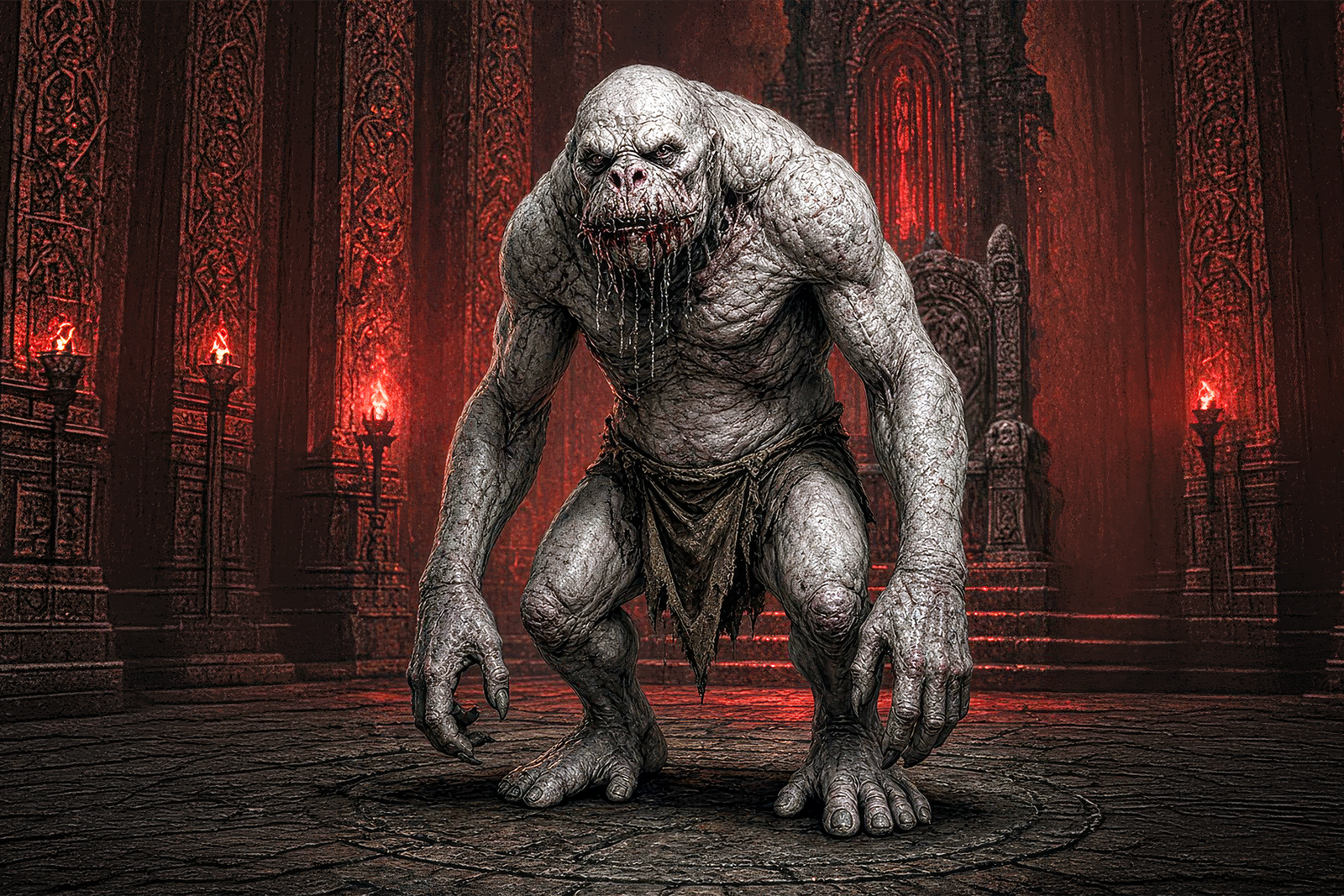
Wadhels are believed by many scholars to represent an early failed attempt at creating the Camonra. Though physically powerful, they lack the stature and natural intellectual gifts of their successors. For centuries they have existed as the slave class of Durageim, performing labor, maintaining prison systems, hauling corpses, and serving the needs of Broeden's court.
Appearance
Wadhels stand roughly waist-high to most humans when fully upright, though they commonly move using their elongated arms as additional limbs. Their gait resembles a powerful knuckle-supported stride. They possess massive shoulders, oversized hands, dense musculature, pale skin, and mouths permanently sewn shut, leaving little movement, save enough for the gruel and tiny pieces of food that will pass their lips.
Origins
Most historians believe the Wadhels preceded the Camonra. The experiment succeeded in creating strong and durable laborers but failed to create the warrior-scholars desired by their creators. Rather than destroy them, Broeden retained them as a permanent servant caste.
The Stitched Mouths
The most infamous feature of Wadhel society is the ritual sealing of their mouths at birth. Initially intended to suppress speech among a supposedly unintelligent servant race, the practice endured long after the Wadhels demonstrated the ability to learn, remember, and reason. What may once have been control became institutional cruelty.
The Silent Language
Denied speech for generations, the Wadhels developed an elaborate sign language of gestures, posture, touch signals, and visual cues. Within Durageim this silent language functions as a complete means of communication and has become a central component of Wadhel culture.
Many outsiders mistakenly assume Wadhels are incapable of meaningful communication, a misconception that allows them to operate largely unnoticed throughout the fortress.
Role in Durageim
- Dungeon attendants
- Prisoner transport
- Corpse disposal
- Court maintenance
- Labor and construction
- Death Pit operations
Wadhels frequently escort captives from the dungeons into Broeden's presence and are among the most commonly encountered servants within the fortress.
Psychology
Centuries of servitude have produced a people who appear submissive to outsiders. Yet many Wadhels possess far greater intelligence than their masters assume. Their isolation has encouraged the development of a hidden culture built upon memory, routine, loyalty to one another, and silent observation.
Potential for Resistance
Because they move freely through areas inaccessible to most prisoners and visitors, Wadhels occupy a unique position within Durageim. Some scholars believe that if given hope, they could become one of the greatest internal threats to Broeden's regime through subtle acts of defiance rather than open rebellion.
Settler Lore
The Camonra build armies. The Wadhels build everything else.
The saddest thing in Durageim is not the dungeon. It is the ones carrying the keys.
They took the Wadhels' voices, but not their minds.
Threat Assessment
Danger Level: Moderate
Individually, Wadhels are strong and capable of violence when cornered. Their greater significance lies in their near-total access to the workings of Durageim. Few beings know more about the fortress and its secrets than the silent servants who maintain it.